
You’ve finally found it! It’s for sale on eBay. You know – that guitar you’ve been dreaming about? The one you’ve lost sleep over. You’ve given up months’ of Caramel Macchiatos… Caffè Lattes… Flat Whites… Blonde Double Shot’s; just to be able to afford this moment!
You win the auction, and finally the guitar is delivered! You tear off the packaging with anticipation when… ooh… you hold your nose. It smells like an ash tray… Maybe the listing claimed “like new” but this baby reeks with late night cigarette and summer sweat smells. Despite the odor, the guitar is in fine shape.
If you’re faced with this not uncommon problem, you might be tempted to pay the return shipping. Or worse, you might just leave the guitar in the case and not play it!
In the following article we’ll share the causes of odorous guitars, and some tips on how you can remove the stink from your own guitar, case, or gig bag.
Let’s talk about the reasons that guitars and gig bags trap odors.
Eric Clapton drew attention for balancing a lit cigarette between the tuning pegs on his guitars. The habit turned out to be popular with a lot of rockers, and consequently there are many used guitars on the market with burn marks. It’s even possible to buy brand new guitars that have been ‘distressed’ with burn marks.
Many of the materials and finishes on modern guitars are made of polymers (plastics). For example, nitrocellulose, used by many manufacturers as a finish on their products was one of the earliest forms of plastic. Unlike bare wood, the surface of a finished guitar is non-porous, preventing particulates from penetrating the wood.
You can tell that your guitar has been finished because the wood appears glossy (reflects light).
If you’ve ever witnessed plastic melt, it’s clear why this type of damage is irreversible. If a cigarette is left on a guitar long enough to burn through the finish, it will also burn and permanently destroy the wood of the guitar. Short of completely refinishing the damaged section of the guitar, it’s hard to clean deeply enough to remove the smell.
The good news is that you can remove the odor from a guitar that hasn’t been burned.
The advantage of a polymer based finish is that it’s smooth enough to simply wipe down. Chances are the source of the smell is in particulates trapped on the surface of the guitar’s finish by the previous owner’s skin grease (or sweat); which has been deposited over time.
As long as the finish of the guitar is intact, to clean non-penetrating surface smells on your guitar:
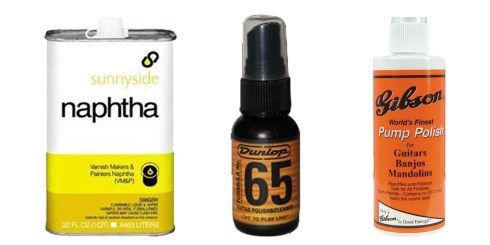
- Obtain naphtha, guitar cleaner, guitar polish; and a few clean, soft cotton cloths.
- Apply a small amount of naphtha to a cotton cloth and thoroughly wipe down the exterior surfaces of the guitar, and let it dry for a few minutes.
- Apply guitar cleaner to a small cotton cloth. Use the manufacturer’s suggestion for the proper amount. Wipe down the exterior surfaces of the guitar, and let it dry for a few minutes.
- Make sure to wipe under the strings, between frets, and small hard to get areas where particulates may be trapped.
- Clean the surface of the strings, pickups, and knobs
- Allow the guitar to air dry before placing back into a case
- Apply a small amount of guitar polish to a cotton cloth and spread on the guitar, buffing as you go.
Some things to consider before cleaning your guitar:
- Avoid dripping chemicals in the amplifier jack.
- Avoid drenching your rags with cleaner, and keep a dry rag on-hand for spills.
- Removing strings and knobs before wiping the guitar down makes cleaning easy.
- Clean the the whole guitar. The back of the guitar gets gross too.
- Use genuine guitar cleaner and polish.
- Some automotive, furniture, and floor cleaners use ingredients that cause guitar finishes and exotic woods to dry out and crack (ex. Limonene, Silicone).
- Check for allergies. Check the label for irritants if you have sensitive skin.
- Ventilation. Make sure to clean outdoors or in a well ventilated area. Follow the manufacturer’s instructions on when to use a mask.
If the smell persists after cleaning the guitar, chances are the case is dirty too. Some people might throw the case out, but if you’ve already paid for it and don’t want to go through the hassle of returning it, there are other options. Since cases are usually made from textile (which is porous) or a mix of textile and hard plastics, it’s both much easier for them to pick up odors and much easier to clean them.
Before trying the steps below, if your case has a removable insert, or your gig bag is machine washable – we recommend trying that. If washing fails to remove the smell or isn’t an option, the steps below are sure to work.
How to remove unpleasant odors from a case or gig bag:
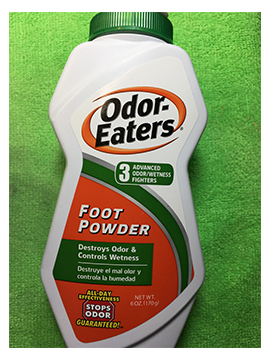
- Sprinkle Odor-Eaters Foot Powder generously on the interior of a hard-shell case.
- For (soft shell) gig bags, sprinkle powder on the exterior as well.
- Close the case and let the powder set for a few hours.
- Remove the powder by vacuuming.
Some things to consider before cleaning your case or gig bag:
- This is messy. Clear adequate space, and keep your work area out of the reach of small children and pets.
- Work smart. If you don’t have a hard surface to work on, putting down a plastic bag or sheet may save you some extra cleanup.
- Do not spread odor eaters powder over your guitar
We hope you’ve found this article about removing unpleasant odors from your guitar informative and enjoyable. If you enjoyed this article we would appreciate your support with a like, comment, or a share!
It’s Guitar Chief’s mission to put affordable instruments in the hands of every deserving musician, and to help you to keep playing. We live in St. Charles, IL and regularly participate in community events in Geneva, Batavia, Chicago, and much of Northern Illinois. If you’re looking to buy guitars, sell guitars, or have an instrument maintenance question, we would like to be a resource for you!
 Lovingly Restored | Passionately Played